"My father's father has told me of the Red King. His very city is no more. Dost thou not see it is vanished?" 
- The Red King and the Witch 
from F.H. Groome's Gypsy Folk Tales, 1898


CONCRETE & THE RED KING
A Toponymical Exploration of Toronto's Concrete Ruins
Conducted Between 2007-2014

Portion of the Crothers Woods Complex, southern section

PREFACE

The following details a series of site visits conducted within the city of Toronto mainly between May of 2007, and April of 2014 (with supplemental photography, in certain cases, provided some years before and after these dates). As such, many of the sites examined herein may no longer appear as depicted or described.

Moreover, since the method of survey employed at these sites was predominantly of a cursory and informal nature — with measurements, coordinates, and other specifics based largely on estimates or approximation (and, occasionally, on nothing but later recollections) — much of the information presented henceforth should be deemed as less than exacting to begin with.

This amateur's approach has also carried over into the research and analysis portion of the text. The author, claiming no expertise in any of the fields discussed, admits only to a speculative engagement with the evidence at large, and a passing familiarity with the resources at hand. Thus, let the reader be forewarned that while everything which follows might be roughly factual, none of it, in the end, may be actually true.

INTRODUCTION

A selection of local treatments

What is it that makes up the visage of a place?
What matter makes its skin, its bones?
What substance holds a site together?
What material comprises the structure of its soul?

"Toronto is a concrete city," reads the blurb aback E.R.A. Architects' 2007 monograph Concrete Toronto. "Looking at its international landmarks, civic buildings, cultural institutions, metropolitan infrastructure, and housing, from high-rise to single-family home, it is clear that much of Toronto was born in an era when exposed concrete design was the order of the day."

Against the modish ascent of glass facades, wherein the current city skyline threatens to disappear into its own translucent reflection, this sentiment may seem increasingly moot. Still, one cannot deny the intended and continued prominence of such structures as the CN Tower, New City Hall, the SkyDome, and various other buildings, erected mainly during the latter half of the last century, in which concrete serves not only as a skeletal frame but also the unadorned flesh of the edifice itself. Everywhere across this city one finds the grey, beige, and rust-stained reminders of Toronto's concrete epoch; be they in the coarse ripples of a bush-hammered finish, the cold solidity of a smooth-treated formwork, the rustic terrazzo of a pebble-mixed aggregate, or the rough precast furrows of a broken-rib panel. Clearly this material held a certain fascination for many of this city's builders. But why this material? And how deeply have these foundations been poured?

As to the first question, there are certainly practical efficiencies to recommend concrete as the stuff of construction beyond any aesthetic or historical considerations. In contributing to the abovementioned work, structural engineer Chris Andrews extols that:

Concrete is a unique, almost magical, building material. The primary constituents of concrete — including sand, stone aggregate, water and cement — appear to be benign, nearly inert materials. However, when mixed in a carefully proportioned manner, they form a flowable slurry that can be placed into temporary forms and left to sit for as little as 24 hours; through a chemical reaction, the liquid-like material transforms into a mass of hardness, surface characteristics and colour properties similar to that of natural stone ... Other unique properties of concrete include spontaneous heating of the material as it sets, shrinking of the material as it cures and ongoing strength gain if it is kept damp. It has a coefficient similar to that of the thermal expansion to steel. This last feature allows reinforcing steel and concrete to behave compatibly during variations in temperature and allows reinforced concrete to work in the Toronto environment.

Such "unique, almost magical" properties may have led somewhat towards its aesthetic celebration as well, although practical (namely economic) efficiencies have, again, likely played the larger part in this regard. As to any historical considerations, however, this brings us to the second and, perhaps, the more intriguing of the two questions at hand. Though commonly thought of as a recent invention, as Andrews goes on to note, "the development of modern concrete goes back at least 5,000 years, to the initial emergence of lime plasters," stating further that, "the Romans then improved on this material by adding what initially looked like a sand material [pozzolan] found in the vicinity of volcanic areas." This new concoction, known as opus caementicium, set off an architectural revolution that would give birth to some of antiquity's most famous buildings; from the Colosseum, to the Pantheon, to the Baths of Caracalla. Moreover, while it was not until the mid-19th century that we find concrete reinforced with steel rebar of the contemporary sort, the same principle has been applied since ancient times via wooden beams, granite columns, iron chains, and so forth.

That being said, with respect to the concrete history of Toronto, official records attribute a chronology in accordance with this material's more recent past. A pattern shop, built around 1890 as part of the great Massey-Harris factory complex near King and Shaw Streets, is generally thought to be the original seed which spawned everything else so far discussed. Yet beneath this surface layer of municipal architecture, another stratum of concrete construction — vaguely out of place, and queerly out of time — lies seemingly lost and found throughout the wilder tracts of the city, raising further questions about the true roots of this phenomenon. Specifically, one may look to any number of mysterious ruins scattered freely across the metropolitan landscape; some lorn within its sunken woods and vacant fields, others hidden in plain sight amongst the more decorous furnishings of its well-trodden parkland. All differ in appearance, composition, and extent — yet all stand united in their inscrutable peculiarity.

Here, it should be noted, we use "ruins" in the broader sense of the term, referring not only to those dilapidations plainly ruined through neglect and the passage of time, but also to those structures of a more indeterminate nature that may, or may not, still stand as intended, but whose purpose has long been forgotten or abandoned. Indeed, many of the ruins described in the following might be said to straddle both categories, if not tend towards the latter. As such, it could also be said that we use "mysterious" in, perhaps, a somewhat redundant sense, as all ruins are, to a certain degree, mysterious; inherently evocative, intrinsically enigmatic. We need not rehash the musings of a Byron, a Chateaubriand, or a Macaulay on this subject, nor quote of The Ruin or Ozymandias. They speak well enough for themselves — and on our behalf, too — victims, as we all are, of relentless time's burden; sacrifices to progress and degeneration alike. But, of course, not all of their mystery is so weightily ruminant. Beyond begging of creation why hast thou forsaken me?, ruins pose other questions of a more immediate sort. We seek out their builders, their function and form; the dates of their construction and the cause of their collapse. Then, even when such details are said to be known, we are still often left to ponder why what remains has remained, why in such a place, and why in such a configuration. These are the mysteries we hope to unravel here — or, at least, intend to investigate as far as any evidence permits.

To that end, there are certain obvious resources one would expect to consult in pursuing such evidence. Yet the books, maps, and assessment rolls remain largely silent on the structures in question. What does speak to us, however, is that most constant resource of all historians, geographers, and archaeologists in these matters: toponymy. Naming, of course, is a fundamental tool in any attribution of meaning, thus much can be learned of a place and, by extension, its artifacts, through the proper study of its various names. Just as with etymology, where one may trace not only the linguistic development of a word, but also the ideational development of the concept behind it, so too with toponymy one may trace not only the cultural development of a site, but also its geographic and functional significance. By correctly understanding its name alone, one need not be familiar with the history, or even the location of, say, "Palermo" to deduce that it was settled successively by Greeks, Arabs, and Italians (Palermo being a Sicilianized version of Bālarm, itself an Arabic interpretation of the Greek Panormos), and that it was likely an important coastal trading city (with Panormos meaning "total port" or "complete harbour," from πᾰν + όρμος). Of course, not all toponyms are so "total" or "complete" in detail — and even with all of the information packed into a "Palermo," this name gives no indication that the city was originally founded by Phoenicians under the moniker of Ziz (meaning "flower"); nor would any of this information be pertinent if we were investigating the origins of Palermo, Ontario (named in honour of Vice Admiral Horatio Nelson, "Lord of Palermo" among his many other titles). Likewise, lacking any further data, one might ceaselessly ask if a certain "Holy River" was so named because it flowed past an ancient temple, or if the temple was built there because the river was already deemed holy. Nevertheless, lacking any further data, remnants found in the vicinity of a "Millbank," "Millford," or "Mill Road," for example, may, in most cases, be reasonably associated with some sort of mill until somehow proven otherwise.

Unfortunately, in a modern urban setting like Toronto toponyms are rarely that descriptive of the site itself. Streets, parks, and neighbourhoods more often commemorate the early settlers, local land owners, and other notable residents of an area. They will also typically appeal to locations and figures of some significance elsewhere, or to simple aesthetic conceits deemed marketable by realtors and property developers. These, at least, are the conventional explanations for most of the names one comes across. But then there are certain appellations which appear mysterious as any of the ruins we seek to explore.

Strange names in strange places, February 2008

Why, for instance, do we find in the eastern realms of North York a "Lucifer" Drive? Who, or what, exactly, is being appealed to here? What should one make of the fact that, during its short span, this street also happen to intersect with both a "Warfield" Drive, and a "Faye" Drive ("nickname for someone believed to have supernatural qualities," from the Middle English faie, meaning "fairy," according to the Oxford Names Companion)? And, for that matter, why have we a "Warlock" Crescent, a "Wyvern" Road, or a "Wendigo" Way in other parts of the city? Such names would seem to compel investigations of their own, if not invite further scrutiny into what may lie behind all those of a supposedly more prosaic breed. To further demonstrate this unusual interplay of names and locations, let us now look behind the nomenclature connected to an actual ruined site; eschewing, for the moment, any of the official given history for the local toponymy, while looking, instead, directly into the surrounding names themselves...

TODMORDEN ALIGNMENT

Looking north, May 2008

Along the Todmorden Mills stretch of the Don River, nestled into a wedge of infrastructure formed by the CPR Don Valley rail bridge and the DVP/Bayview Extension interchange, one will find the site in question. This particular ruin, it should be said, is not of the concrete variety, but rather of that other "compatible" material which constitutes our locally preferred reinforced compound: steel. Nevertheless, this is, perhaps, Toronto's most unusual ruined site, for here, overlooking the river from a steep embankment, hundreds of metal highway barriers have been stuck into the ground for, seemingly, no apparent reason.

The overall impression one gets from this oddity is decidedly megalithic, with the site spread out like a miniature Carnac, running roughly 100 meters along the incline with its corrugated menhirs placed haphazardly throughout; all thrust into the earth at various depths and angles, some standing vertically, 2 to 3 feet high, others barely breaking the surface of the soil, or jutting perpendicular from the hillside. As such, the other impression one is likely to get from this site is that of a mass of toppled grave markers in some long abandoned burial ground. Of course, the location and materials involved would tend to preclude any such fanciful interpretations, but if we look to the relevant toponymy, one can't help but be struck by certain curious correlations.


Additional views from 2008

"Todmorden," to begin with, harkens to a village in northern England straddling the traditional border between Yorkshire and Lancashire, just as the present Todmorden Mills sits in the historic borderlands between the old township of East York and the old city of Toronto. The ultimate origin of this name is somewhat obscure. The Oxford Names Companion has it fittingly translated as "boundary valley of a man called Totta" (tracing back from the earlier Tottemerden, an apparent construct of the Old English Totta + maere + denu). However, a persistent folk etymology would have the translation coming closer to something like "a woods" or "valley of death," taking the first two syllables from separate linguistic strains to express the same morbid concept twice (Germanic/Old English todt/toth + the Latin/Old French mort). In fact, this theory finds some support in the existence of a local feature known variously as Blackheath Circle, Blackheath Barrow, or Roman Barrow — another megalithic site in the form of an ancient ring cairn which, by all archaeological accounts, served as the venue for sundry prehistoric funerary rites (interestingly, this cairn also seems to be unique in its isolation from any other known ritual sites or settlements of like vintage in the area). Meanwhile, our local Todmorden's deathly connotations are vaguely bolstered by the adjacent commencement of Mortimer Avenue — a name of probable Norman French ancestry, combining morte + mer to equal "dead water" or "waters of death" — and how strangely synchronous that we should have this potentially fatal site right next to a major river.

As seen in April, 2017

Of course, this is all highly conjectural, if not flatly coincidental. "Todmorden" was merely the home village of one of the mill's proprietors, most will argue. "Mortimer" was simply the name of some early settler, local land owner, or other notable resident. But then there's still the ruins. How to account for them? And how to account for all the others we have yet to define? It's hard to say. But let us attempt to account for as much as we can, and begin our investigations in earnest by putting this conjectural approach into practice just a little further to the north.
CROTHERS WOODS COMPLEX

Portion of southern section, February 2008

The Todmorden site lies at, or just beyond, the southern extent of what is commonly referred to as Crothers Woods. "Crothers" is, of course, a variant of the Scottish surname Carruthers, which the ONC has deriving from Caer Ruther, an ancient British toponym meaning "fort of Ruther" — itself a name likely descended from the Gaelic ruaidhri or "red king" — and, indeed, if one ventures further north into the heart of Crothers Woods proper (along a bend on the east bank of the Don, in an area recently branded as "Cottonwood Flats"), you will find many scattered remnants of what one could imagine as some bygone fortification.

We are told this property, too, was once the site of a mill. Then, a century-or-so later, an insulation factory stood somewhere in this vicinity. From the 1960s until 2009 this area was largely vacant, used only to hold snow plowed from local streets during the winter. None of these purposes, however, quite recommend themselves to what we find. Ruined stacks of concrete slabs near the south Bala rail crossing very much resemble what might have been a complex of bunkers, while similar rubble further north along the riverside suggests the remains of an erstwhile defensive wall. One might also, in seeking a megalithic analogue to the nearby Todmorden site, summon images of the various dolmens or gallery graves found throughout prehistoric Europe (certain formations at Locmariaquer, in particular, come to mind).

Northern formation, November 2016

As for dimensions, the northern wall measures about 30 meters by 4, standing 5 slabs tall on average (or roughly 5 feet high). The "bunker complex", meanwhile, covers an even larger, if somewhat more amorphous area; measuring about 60 meters in length to upwards of 20 meters in width, all while breaking off into various uncovered and semi-covered chambers (some being directly connected, with others standing slightly off in isolated adjacency). Together these constructions form what is possibly the most extensive set of ruins in the city, running approximately 250 meters along the river, end to end, with numerous scattered remnants found between the two main structures, suggesting a once much greater "fort of the red king."

As to the "red king" in question, historical suspects (with regards to the surname, at least) would include Rhydderch Hael, Brittonic king of Alt Clut (present-day Strathclyde, c. 580-614); William Rufus, Norman king of England (c. 1056-1100); and Ruaidrí (Rory) O'Connor, the last High King of Ireland (c. 1116-1198) — with the "redness" of each king generally assumed to be describing some physical characteristic, either red hair or a ruddy complexion. At this early juncture, however, it might prove hasty to limit ourselves to such commonplace explanations (with regards to the ruins, at least). Continuing with our conjectural approach, if one looks outside the annals of conventional history one notes that the title of "red" or "crimson king" has often been applied to the aforementioned Lucifer, as well as many lesser tyrants of a devilish nature (be they factual or fictitious), with red variously symbolizing blood, hateful rage, or the flames of infernal hellfire. Indeed, the concepts of monarchy, tyranny, and the colour red were often so intertwined as to be held in virtual synonymity. In early heraldry red and purple (the official colour of royalty since, at least, Roman times) were generally interchangeable under such headings as "French red," "vermillion," or "gules" — and, as we learn from the Llyfr Dysgread Arfau, a Welsh heraldic treatise of the late 14th century:

This colour is forbidden by civil law to be worn without permission, except by a prince; and whoever transgresses may be executed. And why is this colour ordained to a prince more than white or black or blue or gold? Because this colour represents cruelty, and a prince ought to be cruel to his enemies as it behoves him to punish disorder.


Interstitial rubble, 2016

That said, we should also make mention here of that most benevolent of Welsh princes, Arthur, who has, at times, been heralded a "red king" by association with the Red Dragon of Wales (as opposed to the White Dragon of the Saxons). Then, of course, there was King Henry VI, instituted under the Red Rose of Lancashire, who vied with the White Rose kings of York for the throne of England in a war which resulted in the establishment of the Welsh House of Tudor. Even further afield, one might point to the mythical reign of Horus, and the subsequent dynasty of "red kings" who wore the deshret, or "red crown" of Lower Egypt (as opposed to the hedjet, or "white crown" of Upper Egypt). And then we may note that the pseudo-historical Egyptian sage Hermes Trismegistus, in symbolizing the filius philosophorum, is often depicted as the product of an alchemical wedding between a Red King (representing sulphur and the sun) and a White Queen (representing mercury and the moon).

As talk of alchemy so often precedes talk of Tarot, astrology, or some allied esoteric diversion, let us also briefly note that The Emperor of the Major Arcana is traditionally depicted in red or crimson vestments, while in a standard (i.e. English pattern) deck of playing cards the two "red kings" are made conspicuous by certain peculiar distinguishing features: the King of Diamonds being the only king to appear in profile, as well as the only king to wield an axe instead of a sword; and the King of Hearts being the only king to appear without a moustache, while seeming to plunge his sword directly into his own head, thus earning him the colloquial epithet of "Suicide King." Returning now to the topic of alchemy, we note how the hermetic Red King, prior to his meeting with the White Queen, is often said to undergo a suicidal purification by drowning, as exemplified in such texts as the Splendor Solis. This red and white union has also been portrayed in the form of two lions, while another common alchemical motif is that of a lion devouring the sun (i.e. the Red King). We now observe that the sun is the "ruling planet" of Leo in the zodiac, while the primary star in the constellation Leo, Alpha Leonis, is known also by its traditional name Regulus, Latin for "little king."

Within the realm of literature and legend, a Red King (or, rather, his three piscine sons) appears in the Thousand & One Nights, during the tale of Judar and His Brethren, as keepers of the treasure of Al-Shamardal. Another Red King, and his three sons, appears in the Romani fable of the Red King and the Witch, wherein his youngest son seeks and finds immortality, only to lose it upon opening a treasure from the past. Finally, we might make passing reference to Lewis Carroll's Red King (again, the counterpart of a "white" rival) who sleeps his way through Through the Looking-Glass, leaving Alice (and the reader) to speculate who, after all, might be but a figment of whom's dream.

Southern formation, November 2016

Such a list, of course, is not meant to implicate any one of these varied, often implausible "red kings" as the Red King of either the surname or the site. It is only meant to demonstrate how prevalent this archetype seems to be. As a recent paper on The Origin of Robin Hood Mythology (Moxon, 2012) states: "the‘red king’ is an apparently generic mythological figure (though proper scholarship on this appears rare): the annual sacrificial victim, whose blood is spilt on the ground to ensure its fertility." Here the author traces the roots of the name "Robin Hood" back to an etymological conflation of said "red king," a "maiden-queen," and the devil.

If we were now to expand the role of "king" to include both celestial and terrestrial rulers, that is to say permit a "red god," this list grows exponentially. Given the Celtic nature of the name in question let us sate ourselves here with just one example: Dá Derga, titular deity of the Irish tale of Togail Bruidne Dá Derga (The Destruction of Da Derga's Hostel), who's name literally translates as "Red God." This tale is part of the Ulster Cycle of stories, otherwise known as the Cróeb Derg or "Red Branch" Cycle, a name referring to one of three royal houses belonging to the mythical king of Ulster during the times of these legends. We bring this particular example up not necessarily to draw associations between our "red king" and this "red god," but rather to draw a certain distinction; for one of the other houses of Ulster was the Cróeb Ruad, also meaning "Red Branch" as we have seen with ruaidhri above. It now becomes clear that we are dealing with two different types of "red." The first (derg) being a bright red, the "colour of blood, flame; also of orange or tawny hue as of ale, gold, etc." in the words of the Royal Irish Academy's Dictionary of the Irish Language. The second (ruad) being "red, of a brownish or dark red (opp. to derg = bright red), oft. of blood-stains." Indeed, the very designation "red" may be somewhat misleading as the ancient Irish may not have even viewed these as related shades of the same colour, but rather as completely different pigments, much like how English speakers tend to view "pink" not merely as some shade of "light red," but rather as a separate colour all of its own. We can, at very least, say these terms were conflicting on a certain level as we note another famed "red king" of Irish myth, Rechtaid Rígderg, who was so-called for having the blood of his predecessor, Queen Macha Mong Ruad ("red haired"), on his hands. In any case, it would seem that the specific "red" of Crothers Woods falls somewhere within the crimson-garnet-maroon spectrum, rather than any vibrant scarlet, or candy-apple tone.
  YELLOW CREEK PILLARS

Roxborough site, March 2012

Heading now about the same distance south from Todmorden as one would head north to Crothers Woods, we encounter another colourful feature of the landscape: the mouth of the Yellow Creek. While no specific evidence appears for any concomitant "yellow king," certain regal implications would seem to emanate from the nearby grounds of Castle Frank and the all-imposing Prince Edward Viaduct (it may, or may not, also bear mentioning that much of the Red Branch Cycle of legends, as cited above, is contained within a manuscript known as the Leabhar Buidhe Leacáin, or "Yellow Book of Lecan").

Travelling up this tributary of the Don, we are not long in finding more remnants of strange structures past. On the northeast bank of the creek, right across from Craigleigh Gardens, two rectangular pillars stand ahead of a chain-link fence seemingly belonging to disused tennis court. Both would appear related (currently or formerly) to a property on Beaumont Road which runs atop the hill directly above this site. Each pillar stands approximately 7 feet in height, 2 feet in width per side, and is comprised of a random mix of concrete and natural stone masonry. A rusted length of chain attends to the northwest pillar, while a rusted metal bracket extends an inch or so near the top of both pillars on the sides facing one another (though angled in opposite directions).

Beaumont pillars, 2012 and 2017

In examining the pertinent toponymy around these pillars, we find in "Beaumont" an English surname of Norman French extraction meaning simply "lovely hill," with its only distinguishing feature, according to our ONC, being that it is "most common in Yorkshire." "Craigleigh," meanwhile, at first seems a face-value mixture of the Gaelic craig, meaning "rock," and the Old English leigh, meaning a "meadow," "glade," or other such clearing. If, however, one were to seek more linguistic uniformity, we might look toward the similarly named Irish townland of Craiglea, meaning "grey rock" entirely in its own Celtic tongue — and it is true that the Craigleigh pillars are, indeed, made of grey "rocks." But, aside from this rather banal fact, there seems little more to be said for either etymology.

Of more apparent intrigue are the pillars themselves; this pair of rubble stanchions left standing apart from their vanished past, a tacit gateway from nothing to nowhere. Western and near-eastern history is, of course, replete with examples of, and reference to, specific twin columns: from the Pillars of Hercules, or the Pillars of Zeus Lykaeos in Greaco-Roman mythology; to the Boaz and Jachin pillars of King Solomon's Temple, sacred in both Hebraic and Masonic tradition; to the dual obelisks which guard the Egyptian likes of Karnak, Luxor, and Heliopolis. Speaking more broadly, the gateway is a universal symbol of transition, rebirth, and rites of passage; found in instances too numerous to even hazard an inventory. This gate, however, leaves little room for passage today, tightly hemmed in as it is between the fence and a small offshoot of the creek. One wonders if this was not purposely done.

A little further along these lines, and a little further up this section of ravine, we now find a jumbled mass of ruins along the southwest side of the creek right before heading under Mount Pleasant Road where it divides Roxborough Street from Roxborough Drive. Here, amongst various bits of rubble scattered throughout the woods, lay three more rectangular concrete pillars — albeit, three of a rather different composition than the first pair, with each being around 5 and a half feet in length, 1 and a half feet in width, then divided into solid, smoothly cast facades at one end, and roughly pebbled aggregate facades at the other. One might presume a diminished gateway-type function for these fallen pillars as well; but a three-pillared gateway, it must be noted, is no ordinary gate, allowing for not just 2, but 6 possible directions of trespass, thus making for a truly higher dimensional threshold.

Roxborough ruins, 2012 and 2017

That said, we should also note that the pillar need not come in pairs (or triplets), nor even remain standing to hold symbolic significance, observing that the broken or fallen pillar is emblematic of various, often somber notions such as the decline or fall of an institution, a piece of work or business left unfinished, and, most commonly, the looming inevitability of death (the broken column being a common motif in grave-marking). To that end, we must recall that Mount Pleasant Road derives its name from the renowned cemetery which it bisects (and not vice versa as is commonly assumed). Indeed, it was purpose-built as an access to this historic necropolis which houses, perhaps, Toronto's most celebrated collection of curious headstones, extravagant tombs, and otherwise remarkable monuments. Furthermore, we again find a remote correlation beyond these shores in the famed Mount Pleasant Henge of Dorset, England; itself a neolithic burial site which, in time, lent its name to an entire period of British prehistory. No direct correlation, however, should be supposed between the names themselves as the cemetery dates from 1876, while the henge was only re-discovered (and re-titled) in 1936.

As for that name, we have in "Mount Pleasant" a common toponym duplicated throughout the English-speaking world, denoting any hill with an agreeable view or scenery — and, as such, something of an inverted correlate to the previous "Beaumont." Of some additional interest is the extended etymology of the word "pleasant" which, if we trace back through its Middle English, Old French, and Latin sources, we'll arrive at a hypothetical Proto-Indo-European root *pelh-, *plak-, or *p(e)laq- (depending on your PIE dictionary of choice), meaning "to be flat" (viz. flat > smooth > calm > placid > pleasant). So, in "Mount Pleasant" we are also left with something of a paradox or contradiction, that is to say a "flat mountain." We are then reminded of the contradictory nature of these pillars, both in relation to the still standing columns of Beaumont Road, and in relation to themselves, being at once half smooth and geometric, half raw and organic in shape.

As for "Roxborough," this is certainly a derivative of the Scottish Borders parish of Roxburgh, whose name we can trace from the genitive Old English (or Old Norse) given name of Hroc (or Hrokr) + the Old English burh meaning "fort" or "manor." If we delve further into the meaning of the first component we find "Hroc/Hrokr" to be descended from an ancient Germanic root pertaining to that European cousin of the crow or raven, otherwise known as a "rook." Here, too, we seem to be met with an established harbinger of death and ill omen, although such birds of the corvus genus have, at times, found themselves associated with more favourable traits like wisdom, prophesy, fertility, and long-life (note their connection with such mythic figures as Odin, Apollo, Athena, Mithra, Morrigan, and Brân; as well as many Christian saints such as Anthony, Ida, Benedict, Vincent, Oswald, and Paul the Hermit). If from here we were to take one step further into unproven hypothesis, and now link "rook" with the homonymical chess piece, we should have ourselves in "Roxborough" a doubling-up of the fortress image while strengthening ties to the "red king's fort" in Crothers Woods — but this is, perhaps for now, a step too far.
AVOCA POOL

As seen in May, 2007

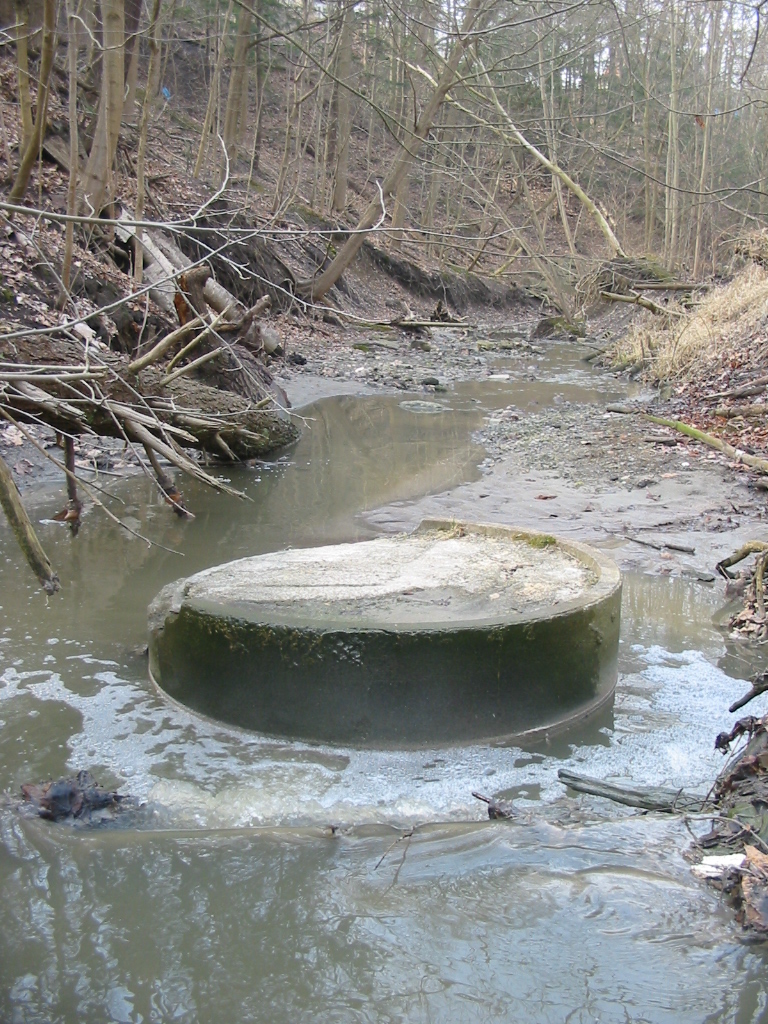
If we now follow the Yellow Creek a few steps further north, back to roughly the same latitude as the Crothers Woods ruins (adjusting for municipal alignment, as opposed to magnetic bearings), we will find yet another curiosity hidden in the shadow of the St. Clair Viaduct, just within striking distance of Mount Pleasant Cemetery. A few hundred yards south of the bridge, sunk into the western slope of the poetically named Vale of Avoca, is a lorn circular pool, approximately 5 feet in diameter, rimmed with moldering concrete stones and filled with the stagnant rains of unfathomed years.

Significantly distant from both the homes of the residential area above it, and the well-tread environs of Balfour Park and the creek below, the situation of this rather inaccessible pool seems especially puzzling, lacking any apparent connection to anything else. One is left to assume that it was once a destination in and of itself, as if some long forgotten woodland shrine. Here, we need only consider the various religious and cultic traditions that have, throughout the ages, made use of votive pools, wells, and fountains, to set the mind at turning.

Beyond such faint supposition, though, this artifact leaves scant traces to go on. At first glance, little seems to be gleaned from the immediate toponymy. "Balfour" is simply a Scottish habitational name meaning "farm house" or "house in a pasture," while "Avoca" finds its namesake in a river and the surrounding areas of County Wicklow, Ireland. The initial source of this name is somewhat obscure, being first recorded in Ptolemy's Geographia as "Oboka" (although this is likely a cartographic conflation with the River Liffey just to the north, having labelled the actual Avoca as "Modonnos"). As to the meaning of this name, Rev. P. Dempsey in his 1912 work Avoca: A History of the Vale, presents such options as "battle of rivers," "meeting of rivers," "crooked river," and "shaded or smothered river," with the only certain element of the name being the avo- prefix, most certainly from avon, the Irish term for a river of any sort.

Looking down from above, 2007

Leaving aside the name, however, we might point out that Wicklow, and the Avoca Valley specifically, are particularly rich in both historic and pre-historic ritual sites. Regarding the latter, one notes the numerous circular cairns and barrows which dot the region, such as the Ballygahan Upper "round barrow," and the "ring-barrow" at Killeagh Hill, both but a short hike from the town of Avoca itself. As to the former, one need look no further than the previously cited work of Reverend Dempsey and his chapter on "Ecclesiastical Ruins" — with perhaps an eye towards "Kilcashel, or the 'Church of the Fort,' or to be more precise, the 'Church of the Circular Stone Fort'" — located, intriguingly enough, at the triangular pinnacle between Ballygahan and Killeagh. Apart from the vale, we should also note that another of County Wicklow's most prominent topographic features is a conical, quartzite mountain known as the Great Sugar Loaf. Many Torontonians of a certain age will then recall that a certain Sugarloaf Hill once loomed over the mouth of the Yellow Creek before its removal in 1959 to make way for the Bayview Avenue Extension.

Looking now towards the viaduct, convention has it that "St. Clair" is a misspelling of the canonized Clare of Assisi, although several other saints have gone by the former spelling as well. In either case, both versions derive from the Latin clarus, meaning "clear," "bright," or in some instances "famous" — all terms one might theoretically associate with a sacred pool. Any further relation between Saint Clare and this particular pool may also lay in the fact that her holy emblem is a monstrance, while she is often depicted with, or represented by a pyx, or ciborium — all typically circular/rounded vessels used to contain the consecrated hosts of the Eucharist. Of additional note she is also, by some customs, the patron saint of clairvoyance and telepathy due to a miraculous vision she is said to have had of a Christmas mass which she was unable to personally attend because of illness. This, of course, naturally leads to thoughts of all the divining pools and otherwise oracular waters consulted throughout history for the purposes of hydromancy — thinking specifically here, perhaps, of the ancient Ionian oracle at Klaros, dedicated to that most "bright" solar god Apollo. We might, then, ask if this pool of Avoca could once have been intended for various evocative rites of mystical invocation?

One last note on the subject, inserted here to add perhaps nothing more than some further gothic tantalization: this pool lays squarely in the vicinity of what was once known as Gallows Hill, a landmark memorializing either the suicide of an early unidentified resident, or the execution ground of certain participants of the Upper Canada Rebellion, depending on which source you choose to believe.
CURIOSITIES OF THE CURITY & FERRIS RAVINES

Abandoned waterworks in Ferris Ravine, May 2012

At this point, a word or two should be said about the fluvial system which so far links all of these sites: the Don River. "Don," of course, was not its original appellation. The Anishaanabe name that the native Mississauga people had for the Don was purportedly Wonscotanach, said to mean either "river of the black burnt grounds" (compare with the Kemet, or "Black Lands" of Lower Egypt's "red kings") or "burning bright point" (compare with the "bright" associations of clarus/Saint Clair). Prior to the Mississaugas, Iroquois and Wyandot tribes inhabited the region, although any names they might have had for the Don were never recorded. This, however, did not stop surveyor Alexander Aitkin from placing the mysterious name Ne-cheng-qua-kekonk on some of Toronto's first city plans, without reference to any source or possible translation.

The present "Don" came about through some alleged resemblance to the river in Yorkshire, England. Its name, in turn, likely derives from the common Celtic word for any sort of river or stream (indeed, a common Indo-European root; see Danube, Donets, Dnieper, etc.) although some would have it arriving from there through the intermediary Dôn or Danu, a Celtic mother-goddess whose own name likely descends from the aforementioned term for running water. In Harold Bayley's 1919 treatise Archaic England: An Essay in Deciphering Prehistory from Megalithic Monuments, Earthworks, Customs, Coins, Place-names, and Faeric Superstitions, such connections between toponymy and theonomy are further outlined:

In the Caucasus — the land of the Kimbry, don was a generic term for water and for river: we have a river Dane in Cheshire, a river Dean in Nottinghamshire, a river Dean in Forfarshire, a river Dun in Lincolnshire, a river Dun in Ayrshire, and a river Don in Yorkshire, Aberdeen, and Antrim. There is a river Don in Normandy, and elsewhere in France there is a river Madon which is suggestive of the Madonna: the root of all these terms is seemingly Diane, Diana, or Dione, and it may reasonably be suggested that the dene or Dane holes of this country, like many other dens, were originally shrines dedicated to the prehistoric Madonna.

Ptolemy's "Modonnos" designation for the Hibernian Avoca must now raise some additional eyebrows, all the while leaving us to guess what, if any, implications this might have for our own Avoca pool. Furthermore, such reference to Diana traditionally of the pre-Roman Italian lunar goddess Diviana, meaning "bright" or "shining one" piques supplemental interest by way of the luminous St. Clair, then by dint of the white moonlight previously linked with the alchemical Red King's queen, and finally through Diana's later Roman pseudonym of "light-bearer," or Diana Luciferia, a name which naturally led to certain conflations with Lucifer (the shining "light-bearer" of the morning star, Venus) during the Christian era. Indeed, to this last point, even in ancient times she was already drawing dark associations with such company as Hecate, Greek goddess of the dead and nocturnal witchcraft.

"Don," or rather Donn, it must now be noted, is also the name of an Old Irish god of death and lord of the Gaelic underworld. He is mentioned in the tale of Dá Derga's Hostel (referred to earlier) by a trio of "red horsemen" who "ride the steeds of Donn," and has thus been associated with Dá Derga himself. Donn has likewise been linked with Dagda, patriarchal god of the Tuatha De Danann, or "tribe of Dana/Danu," the very same goddess mentioned above; while donn is also, according to the Dictionary of the Irish Language, another word for "brown, apparently a light brown inclining to yellow or red," as well as for a "chief, noble, or ruler (poetic)," again suggesting ties with our elusive "red king." To this end, we might recall the previously mentioned Queen Macha Mong Ruad ("red haired"), noting how her father, King Áed Ruad, was said to have drowned in a waterfall known as the Ess Duinn, or "rapids of Donn," which also brings to mind the drowning Red King of alchemical lore. Observing one last "red king" in regards to this topic, we should note that, following Christianization, Donn quickly became a local byname for Satan, as well.

Curity Ravine "denehole", March 2012

With respect to the "dene or Dane holes" referred to by Bayley, these are a collection of mysterious subterranean structures, found mainly in the southeast of England, taking the form of small limestone caves and dug-outs entered from above by vertical shafts. Best guesses relate them to ancient chalk mining enterprises, but nothing definitive can be said of them for certain. In seeking local counterparts we might make reference to the copious outfalls and manholes which tend to accompany any urban waterway. While these, as a rule, are easily enough explained, certain exceptional examples require further inquiry.

One such example in the Curity Ravine (a sub-tributary of the Don by way of the Taylor-Massey Creek) stands out like a bizarre reflection of the abovementioned Avoca pool. Of comparable shape and size, this Curity "denehole" contradicts its opposite in nearly every other aspect. Whereas the pool affects a rough-hewn ring of rustic ashlars, the denehole appears as a smooth circular tube of precast concrete. Whereas the pool holds its waters surrounded by land, the denehole emerges like an island from the middle of a stream. What connects these two artifacts, aside from a common river system, is once again St. Clair Avenue. This road is interrupted for a great distance by said river system, ending just past the pool at Moore Park in the west, and resuming just above the denehole at Parkview Hill in the east. Again, these two features will be shown to inhabit approximately the same rectified latitude, with Crothers Woods laying roughly equidistant between them.

What is remarkable about the hole, aside from its odd location, is the fact that it appears to be purposefully, and permanently filled in — also with concrete, though of a much coarser variety than that of the outer shaft (compare again to the Roxborough pillars). This is perhaps somewhat explicable given its mid-riverine position...but then, it is just that position which makes this shaft all the more inexplicable. If this were merely another storm sewer entrance, or some other utility maintenance portal, one would typically expect to find it off by the side of the stream, not directly in the midst of it. Likewise, if this were any sort of functioning manhole one would certainly not expect it to be sealed over so immutably. In such a state, one can only gather that whatever it was once used for, it is no longer in use; keeping everything outside steadfastly out (and anything inside steadfastly in).

Making our requisite check on toponymy, "Curity" seems to be an uncommon variant of the Irish surname McGerrity, which the ONC has descending by some tortuous route from the Gaelic Mag Oireachtaigh, a noble byname meaning "son of a member of the court or assembly." The original "member" in question here (according to such sources Rev. Patrick Woulfe's Irish Names and Surnames, and C. Thomas Cairney's Clans and Families of Ireland and Scotland) was one Oireachtach Ó Roduibh, with the "court or assembly" in question being that of the O'Connors — selfsame clan of the "red king" Rory O'Connor whom we cited earlier in Crothers Woods. Some coincidence, then, that this ravine just happens to run its length alongside the area's main thoroughfare, O'Connor Drive.

A short trip across O'Connor Drive and we're quick to find another spur of the Taylor-Massey Creek known as the Ferris Ravine; a soggy little trench that runs between Ferris Road and various "Glen"-begun addresses (Glenwood, Glencrest, Glen Gannon, Gleneden, Glenfield, etc.). The ravine is inaccessible by any formal means — and understandably so — being of such little conspicuity that one might suspect it is barely noticed even by those whose properties back on to it. Nevertheless, one can't help but detect signs of much past (and perhaps recent) activity in this rather out-of-the-way region.

Firstly, there appears to have been some aborted attempt at riparian plumbing during one, if not multiple phases of the ravine's history, with decaying segments of concrete and metal piping strewn about the streambed in every direction. Of much greater intrigue, though, are a series of enigmatic markers placed in some of the most remote sections of this already remote location: an old broom, stuck upright into the ground just west of Rexleigh Drive; what appears to be a shovel (or other such implement), plunged downwards into the ground and framed by a primitive niche of branches, just east of Rexleigh Drive; then a makeshift footbridge and four wooden stakes, driven into the ground right where the stream flows under this very street.

Ferris Ravine markings, May 2012

Rexleigh Drive is significant in that it divides the Ferris Ravine roughly in two; and while the western half runs in more-or-less straightforward solitude towards the Taylor Creek, the eastern half abruptly forks around Glen Robert Drive, with the southern prong continuing on as far as Cedarcrest Boulevard, and the northern prong terminating just below the oft-recurring St. Clair Avenue. If we now follow this northward fork the whole of its brief span, two additional objects of note should catch the observant eye: a pair of manholes, not covered as per usual, nor indefinitely closed-off like the Curity hole, but with their lids left invitingly ajar. Nothing in their proximity would indicate the presence of "men at work," nor indeed of anyone having recently been at their location. Still, their expectant condition would tend to suggest they were, at least at one time, the site of frequent visitation.

What, then, are we to gather from this strange assortment? The open manholes, one could assume, somehow relate to the abandoned waterworks project further downstream. But what of those bizarre markers which seem to serve no discernable utility? For what purpose, and for what audience could these curiosities be intended, withdrawn as they are, quite in the middle of nowhere?

Well the broom, to begin with, being an obvious symbol of cleansing, has long served as a fetish for warding off evil — especially when placed with bristles up, typically near a doorway or other entrance to whatever area is being protected. Conversely, its other main association has historically been with witchcraft, and prior to roughly the late 15th century witches were just as likely to be depicted astride a shovel, hoe, or pitchfork as on a broomstick — perhaps suggesting some thaumaturgical connection to the handle further upstream. Most curious of the three marking sites, however, are the quartet of wooden stakes and the little bridge by the culvert heading under Rexleigh Drive. The paltry span and terminal location of this meagre bit of stream certainly requires no bridge to negotiate it; whereas the stakes, all gathered as they are directly at one end, would make it un-crossable in any event (hearkening somewhat to the impassable gateway of Beaumont Road). We must, therefor, assume either some ornamental, ceremonial, or symbolic function for this odd installation...but, again, to what purpose?

Resorting once more to toponymical insight, we have in "Rexleigh," as we did with Craigleigh earlier, another macaronic hybrid — only now the Old English leigh, or "meadow," is adjoined with the Latinate rex which, of course, refers to a "king." If we were again to employ the same Irish-izing trick, turning leigh into lea, we would now have a "grey king" to go along with the "red king" of Crothers Woods — but we would also still be left with a hybrid, and thus little reason for taking such liberties. In "Ferris," however, the concept of some kind of powerful Celtic figure is again reinforced, for that is precisely what the name implies, being a variant of the Gaelic Fergus, itself a compound of fear "man" + ghus "strength." If we now continue to pursue the previous line of thought regarding rex we will uncover the Gaulish/Proto-Celtic word rix, of the same root and meaning, and found in the names of such historic chieftains as Dumnorix, Ambiorix, and Vercingetorix. Analysis of two other aforementioned names reveals Glen "Gannon" to be from the Gaelic fionn, or "white," and Glen "Robert" to be from the Germanic hrod "fame" + berht "bright" — and yet once more we are met with ties (however loose) to previously examined names, and possible associations with some luminous figure, event, or phenomena.

Among the few local street names made protrusive by their lack of a "Glen-" prefix, just north of the ravine we have "Hale" Court, from an Old English word of the same lineage as "hole," used as a topographic name for someone who lived in or by a nook, hollow, or other such recess (a denehole, perhaps?); and "Leander" Court, named apparently after the figure from Greek mythology who drowned in the Hellespont while attempting a swim to his paramour (refer, once again, to such drownings before). Both of these cul-de-sacs extend from a Stag Hill Drive, and, in keeping with these mythic overtones, one now recalls the stag to be a symbol of many mythic characters: be they Cernunnos, the ancient antlered fertility god of Celtic tradition; or Cocidius the Romano-British hunter god (whose name may relate in some way to our "red king" via the Brittonic root-word cocco, "red"); or yet another victim of Grecian tragedy, the unfortunate Actaeon, who was turned into a stag, then set upon by his own hounds, after stumbling upon the goddess Artemis while bathing (the stag being a symbol of hers as well). This tale, in fact, has something of a reverse-counterpart in the Irish legend of Ossian, whose very name translates as "young stag" due to the fact that his mother, Sadhbh, was returned to human form from that of a deer by his father Fionn (see "Gannon" above).

At this juncture, what further thought are we to give to the fact that Artemis is the Greek equivalent of the Roman goddess Diana, whose name we've already seen related to the Don River through Harold Bayley's "prehistoric Madonna" — and then what of the Greek Dodona, first among the Hellenic oracles, whose magic spring and holy grove is thought consecrated to an ancient, unknown mother-goddess; or even the so-called "Celtic Mercury" (recalling again the alchemical White Queen) so often depicted alongside a stag in ancient relief, and most prominently so at the French mountain shrine of Le Donon? Let us simply end our discussion of this site here, with two more rather glaringly-named streets (which, while not directly abutting the Ferris Ravine, do intersect with Ferris Road just to the south) — namely Ravenwood Place and Druid Court — toponyms requiring, by now, little explication; with the former being presaged by the Roxborough ruins, and the latter being somewhat tacitly implied all throughout these investigations.